
-
CHART FAQs

Hastings Borough Council has produced this FAQ to assist interested stakeholders and potential funding applicants to help understand the Connecting Hastings and Rother Together (CHART) Community Led Local Development (CLLD) programme and its ambitions.
We hope you will find in this document, the answers to the most frequently asked questions, informative and useful. However, if there are other questions please email us at chart@hastings.gov.uk. We will be regularly updating the FAQs as questions arise, so please check back often.
Chart Frequently Asked Questions (FAQ)
1.CHART CLLD Overview and Work Packages
The programme will focus on supporting the areas of Hastings and Bexhill which are in the 20% most deprived Lower Super Output Areas (LSOAs) in the country, using data from the 2010 Index of Multiple Deprivation report.
- Area 1: Hollington, Wishing Tree
- Area 2: Central St Leonards, Gensing and Castle
- Area 3: Ore, Tressell, Baird
- Area 4: Central Bexhill, Sidley
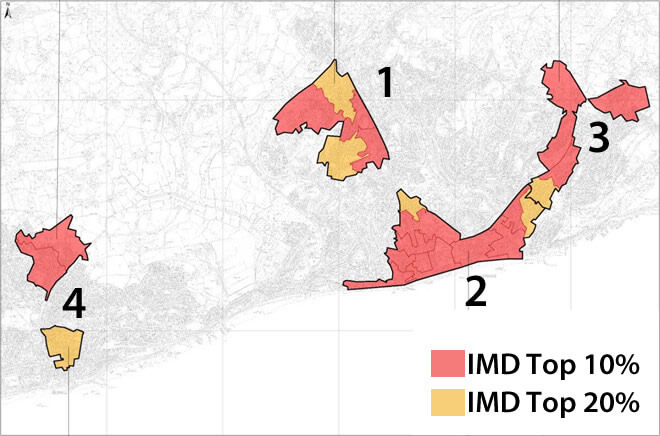
Please see the list of LSOAs below, and use the postcode checker to see if you are in the CHART area.
The CHART Areas (LSOAs)
Hollington LSOA code (2011) Ward Name LSOA Name Population
(Census 2011)Overall %
IMD 2010E01020993 Hollington Hastings 003A 1,344 6.20% E01020994 Hollington Hastings 003B 1,533 10.70% E01020995 Hollington Hastings 003C 1,435 5.40% E01021019 Wishing Tree Hastings 003E 1,597 3.30% E01021020 Wishing Tree Hastings 006D 1,849 14.20% Total 7,758 Hastings Town Centre and Central St Leonards LSOA code (2011) Ward Name LSOA Name Population
(Census 2011)Overall %
IMD 2010E01020978 Castle Hastings 009A 1,951 8.10% E01020979 Castle Hastings 009B 1,836 2.40% E01020980 Castle Hastings 009C 1,588 7.10% E01020981 Castle Hastings 009D 1,629 19.00% E01020982 Central St Leonards Hastings 011A 1,744 1.00% E01020983 Central St Leonards Hastings 011B 1,656 3.00% E01020984 Central St Leonards Hastings 011C 1,952 3.50% E01020985 Central St Leonards Hastings 011D 1,787 7.50% E01020989 Gensing Hastings 011E 1,756 2.00% E01020990 Gensing Hastings 008C 1,658 10.60% E01020992 Gensing Hastings 008E 1,845 3.20% Total 19,402 North East Hastings / Ore Valley LSOA code (2011) Ward Name LSOA Name Population
(Census 2011)Overall %
IMD 2010E01020972 Baird Hastings 005A 1,549 0.40% E01021005 Ore Hastings 004B 1,616 4.90% E01021014 Tressell Hastings 007E 1,877 13.90% E01021015 Tressell Hastings 005D 1,603 0.80% Total 6,645 Sidley LSOA code (2011) Ward Name LSOA Name Population
(Census 2011)Overall %
IMD 2010E01021135 Sidley Rother 007D 1,847 9.60% E01021136 Sidley Rother 007E 1,323 3.90% Total 3,170 Central Bexhill LSOA code (2011) Ward Name LSOA Name Population
(Census 2011)Overall %
IMD 2010E01021092 Centra Rother 011C 2,001 14.20% Total 2,001 Total CHART location population 38,976
CHART CLLD brings a fresh approach to tackling entrenched problems which conventional working has not managed to solve. It will focus on:
- helping disadvantaged people to find and keep employment locally
- helping disadvantaged people to set up as self-employed or start a business
- stimulating the local economy to create jobs suitable for local people
ERDF funding focuses on infrastructure, for example, buildings, equipment, and support for business. ESF supports and invests in individuals to gain employability skills and move towards the workplace.
There are two ESF funded Work Packages and two ERDF Work Packages in the CHART programme:
- Work package 1 COMMUNITY ASSETS (ERDF): Investment in physical assets for employability and community benefit.
- Work package 2 ENTERPRISE AND BUSINESS SUPPORT (ERDF): Stimulating local entrepreneurship and business growth.
- Work package 3 COMMUNITY DEVELOPMENT AND OUTREACH (ESF): Work with local communities and organisations to build confidence and capacity to tackle local problems and improve the coordination of responses.
- Work package 4 EMPLOYABILITY SUPPORT (ESF): Direct support to the most vulnerable unemployed / economically inactive CHART residents to move closer and into the labour market.
Yes.
No, applicants are not restricted and can apply for more than one work package. However, you need to be aware that your application will be more complex if you apply for more than one funding stream, as it will require an application for each. The delivery of the project, specifically the monitoring and reporting requirements will also be more onerous and your project management capacity and plans will need to account for this.
No, it must be within the area identified in the CHART local development strategy
No. However, you would need to demonstrate how your project would be accessible to participants and / or businesses being supported, and how it is only the CHART residents/businesses who will benefit from the funding.
2. CHART CLLD Projects
12 hours or 2 days is the minimum for ERDF funded work packages. For ESF funded work packages it is related to the no of participants engaged, with whom and the result achieved.
Yes. The ambition for CHART is to fund large impactful programmes rather than many small projects.
It means that activity has been created and led by the community (through the establishment of a Local Action Group (LAG)). You can check this by making sure that your project helps to deliver LAG objectives.
There are no hard and fast rules as projects vary in what they deliver and to whom. However, the assessment panel will receive guidance on value for money, which will be based on in-depth experience from / comparison with other similar programmes.
ERDF eligibility for this particular output applies to the renovation and build of public and commercial building spaces. This includes the entire area inside the external walls of a building, including corridors, lifts, plant rooms, service accommodation, which is newly built/constructed as part of the operation, or upgraded buildings refurbished, improved or adapted for productive use as part of the operation. The unit of measurement is the square meters brought into productive use for the programme.
We advise that applicants carefully check the ERDF guidance (Application Handbook) before proceeding. Yards and external spaces are ineligible, as are residential units
3. Applicant Eligibility
Organisations must be constituted and satisfy a range of eligibility criteria. These will be available when the programme opens. Individual people may not apply.
A participant is an individual who benefits from ESF funding. All CHART ESF individuals are participants. Participants have to be:
- Residents of CHART area (postcode/LSOA checker)
- Legally resident in UK and able to take paid employment in EU member state.
- Unemployed or economically inactive
- Aged 25 or over
Please see response in question 2.1
We will be prioritising applications with a total investment of £1m or more in the first call.
4. The Application Process
Yes, everyone has to complete the required application forms and go through the bidding process to be considered for CHART CLLD funding
Yes, Stage 1- Expression of Interest. Stage 2- Full application
Work Package 1 &2 will need a separate application from Work Package 3 &4. This is because they are different funding streams (ERDF and ESF) and have different assessment criteria
No, but we do encourage high quality collaboration and partnership working where it demonstrates that a project can meet participants needs. Also, bear in mind that the CHART CLLD programme is likely to be heavily over-subscribed, so working in partnership could be beneficial in this regard.
The target date for the first grant call is 28 June 2018. The next Call will be spring 2019. Timescales will be on the CHART microsite. www.hastings.gov.uk/chart/
Organisations must be constituted. Individuals are not eligible.
5. Match Funding
£3.7M public sector investment needs to be identified in order for the CHART CLLD funding to be drawn down from the Government. Grant applicants who are awarded funding will be asked to show the 50% match funding required for the project prior to approval.
Match funding can take a variety of forms, including through alignment with existing non EU funded projects with similar objectives and project time scales; cash match; the time of staff re-deployed to CLLD activity, etc. Identifying eligible match funding at an early stage is an important part of your application process. All applications need to identify 50% match in order to meet eligibility.
Public sector match funding means that, the organisation supplying the match should either directly or indirectly receive over 50% of its main funding from central or local government. This does not include payments for contracted work.
Non-profit making voluntary and community organisations (whether incorporated or unincorporated) that are registered with the Charity Commission can supply public match funding as long as the registration is maintained throughout the period of the project.
Public sector match funding can also be provided by private bodies designated or controlled by the State.
Sources of match could include:
- Organisations own reserves
- Other non EU public funding bodies
- Charitable foundations and trusts
- Lottery distributors
- Voluntary and community sector sources
- Volunteer time (ESF Work Packages with strict criteria)
- Private bodies designated or controlled by the State
- For others please check with the CHART CLLD programme team
Other EU funding cannot be used to match against the CHART EU funded grant
No
On ERDF programmes only buildings or land can be used as match and only up to certain value thresholds. Please refer to page 3 in the ERDF Eligibility Guidance (November 2017). On ESF see the question / response below.
Volunteer in kind match cannot be used on ERDF projects within CLLD. Volunteer time can be used as in kind match on ESF projects but only for the lead Partner or Delivery partners.
Previous experience of using volunteer time as Match has been that for some organisations the obligations have proved too rigorous. In order to mitigate this, the use of volunteer time as Match must be agreed in advance by HBC as the Accountable Body. We will also require projects to have 10% cash Match funding as a minimum
Match funding will need to be evidenced and in place before an organisation signs a CHART CLLD contract with Hastings Borough Council.
Yes (please refer to ESIF rules for more details).
Part time hours worked by staff on a project should be calculated using the simplified costs methodology.
How to calculate the hourly rate
Hourly rate = latest documented annual gross employment costs / 1720 hours
(if a staff member works part time, a corresponding pro-rata of 1720 hours is to be used e.g. if a staff member works 0.5 Full Time Equivalent, divide by 860 instead of 1720)The figure of 1720 hours is a fixed calculation set in the funding rules, please only use this annual figure even if your staff work a different number of hours.
This is can be found an Annexe I of the handbook under funding rules.
No for ESF funding. Motor vehicles can be used as eligible costs on ERDF funding providing that it is solely used for CHART CLLD only
Not in most cases. Only VAT for direct costs for the project that are unrecoverable from HMRC can be claimed. This can be found in the claiming costs section and Annex I of the handbook
6. Participant and Business Eligibility
Adults (25 and over) from disadvantaged communities in the CHART CLLD area who are not in work but not necessarily on benefit, to help them develop their potential. Within this broad priority we are looking at how to support the most disadvantaged into employment and to stimulate entrepreneurial activity in the most deprived neighbourhoods.
Yes, providing they meet CLLD eligibility criteria e.g. unemployed or economically inactive and resident in CHART Area.
No, not even zero hours contracts
7. Outputs and Results
No.
See CHART handbooks.
8 Claims and Payments
All projects will be paid quarterly in arrears and only upon submission of an accurate claim to the Accountable Body (HBC). The financial claim will need to include proof of eligible expenditure for the full project costs. The words 'accurate claim' are extremely important, because any errors on a claim (e.g. incorrect expenditure or participant evidence) will result in your organisation having to correct the errors and inevitably, delay payment to you. Any evidence anomalies picked up at audit could result in financial penalties / clawback on your organisation. This is why it is vital to get claims 100% accurate. For example, you must provide evidence that the CHART logo and text has been used in all marketing and publicity you produce. Non-compliance will lead to financial deductions. There will also be 10% retention until the completion of the project satisfactorily.
No. Project/ partnerships must be willing and able to cash-flow their project for 6-9 months, and the importance of accuracy and evidence are paramount in ensuring there are no delays in payment to you.
Indirect costs which would normally be shared or apportioned e.g. premises and running costs shared with non-project staff and activity can be included: You can include these costs only as a flat rate calculation: 15% or 40% of eligible direct staff costs.
Option 1: (available for ESF and ERDF) using a calculation of 15% of staff costs to calculate indirect costs; and then adding all other direct costs.
Option 2: (only available to ESF) uses a calculation of 40% of staff costs only to calculate direct and indirect costs (not adding in any other direct costs).
We'll discuss this with you, and reduce the value of the next payment by the amount of the actual underspend (the financial claim process is based on your actual defrayed project expenditure). Variances greater than 15% from contracted expenditure profiles may result in decommitment or withdrawal of CHART funding in line with the underspend policy. Remember, if you don't provide evidence of spend in your Claim return, we can't pay you. We won't pay a Claim solely on the basis of a profile; we need to see the evidence of defrayed expenditure. If you think you will deviate from your spending profile please speak to the CHART team, they are there to help you.
We will discuss the reasons with you, for example whether it was an underestimate of costs or significant issue with the costs. If you think you will deviate from your spending profile please speak to the CHART team, who will advise you.
9. Record Keeping
You will need to keep accurate records to evidence expenditure and outputs. For example:
- Expenditure under standard cost headings (within Granular Breakdown at application stage) that can be disaggregated into individual transactions upon request;
- Evidence of defrayal (payment) including the date that the item was defrayed;
- Originals must be kept for any purchase orders or contracts; receipts or invoices;bank statements; accounting records
- If claiming staff costs: job descriptions; contracts of employment; payroll records and bank statements.
- If claiming apportioned staff costs: staff timesheets that record time spent working on the project and time spent on non-project activity and records documenting how the gross employment costs used to calculate the hourly rate(s) has been calculated
- Verification records for any indirect costs;
- Documentation showing that third party match is eligible and has been received
- Records documenting your outputs- e.g. participant files
- Procurement- compliant and evidence of compliance-e.g. procurement method used, quotes, advertising, scoring methods used, tenders and quotes received, notification, contracts.
- Publicity-Evidence of compliance with EU rules for ERDF and ESF
- State Aid documentation must be kept up to date and HBC informed of any changes which may have an impact on the project
Ideally, originals of the following. (List not exhaustive):
- Financial documents e.g. invoices, receipts, bank statements, cheque stubs, cash books, salary and payroll records;
- Output documents e.g. beneficiary and output forms, evidence collected from participants to confirm they are eligible for support from your project;
- Evidence that you procured goods and services in a fair and transparent way (e.g. advertising, quotes, tenders, scoring etc.)
- Match funding e.g. letters from other funders, grant agreements from other funders, bank statements showing funding received;
- Publicity e.g. photos, leaflets, posters, press releases, press articles, screen shots of websites etc.;
- Evidence of what you did to promote equal opportunities and environmental sustainability;
- Evidence that State Aid rules have been met e.g. declarations from businesses, letters issued to businesses;
- Grant Agreement with us, copies of all the claims and forms submitted to us.
Yes, they can be scans of originals (certified as true copies) or documents that only exist in electronic form-spreadsheets for example
10. Added Value, Innovation, and Duplication
CHART CLLD will not fund the simple continuation of an existing project. Your CHART CLLD project would need to be a clearly demonstrable development from an existing project, for example increasing access to new participant groups in the CHART area that were not served before, or offering new services/training opportunities to participants.
11.Quality, Inspection, and Audit
No, but we expect all CHART CLLD projects delivering training activities to provide high quality learning / skills opportunities and we will monitor and manage these organisations accordingly
Possibly. As accountable body, HBC may be audited by the managing authorities and as part of this process individual grant beneficiaries delivering CHART projects may also be audited. The managing authority may also be audited by the EU who may then choose our programme to audit.
12.CHART CLLD Information and Support
Yes. Please see the news section at www.hastings.gov.uk/chart/
13. State Aid
State Aid is any advantage granted by public authorities through state resources on a selective basis, to any organisations, which could potentially distort competition and trade in the EU. It's only relevant to organisations involved in commercial activities, known as 'undertakings'. This means bringing goods and services to market.
It's important to remember that this can include businesses, charities, public authorities, and non-profits, if they are trading
Support for the individual is not state aid, so most if not all WP4 (ESF) projects will be exempt from state aid. There's a state aid checklist within the CHART CLLD Handbooks. The CHART team will be able to support you as far as possible; however, you will need to obtain legal advice where appropriate. Incorrect assessment of state aid can lead to financial penalties so it is important to get this right. On seeking independent legal advice, it is also important to use an organisation with appropriate knowledge and experience of state aid.
14. Cross Cutting Themes
There are two cross cutting themes for ESF that you'll need to fully integrate in your CHART CLLD project. These are Sustainable Development and Gender equality and Equal Opportunities. You will need to develop and implement an Action Plan on each theme and report to HBC regularly on progress.
15. CHART CLLD Governance
The CHART Executive Delivery Group (EDG) will act as the Investment Panel during the grant application process. The EDG are composed of LAG Board members that represent the local CHART community, businesses, residents and organisations. The EDG will make recommendations on decisions for full applications to the CHART LAG Board. The CHART LAG board will be responsible for approving grant applications.
The original strategy published in 2016 is available at www.hastings.gov.uk/chart. Please note the strategy is currently being reviewed. It needs to be brought up to date and aligned with the funders final agreement which was approved in May 2018.
We are currently recruiting for the Local Action Group. Membership will be confirmed by mid July 2018. You will be able to find a list at www.hastings.gov.uk/chart/lag
Hastings Borough Council is the Accountable Body for delivery of the CHART programme. It will also provide monitoring, compliance, training and claims processing at project level.
16. European Social Fund
A participant can join a new ESF programme straight away, provided they meet all the entry requirements to do so. You will have to think carefully about how this would work for your project.
Scenario 1: Participant A is on a CHART funded project which is claiming the following outputs: over 50; disabled; BME and the result of moving from unemployed to employed (CR04) They are also on another ESF funded project which is claiming the following outputs: Female, ex offender and the following result: improve labour market situation 6 months after leaving (CR07).
In this scenario, the participants can participate in both projects, but both projects need to be careful no double counting takes place. Both projects can enrol the participant as new, with all the usual entrant forms completed.
The projects can achieve a different result i.e. Project 1 achieves a qualification and Project 2 a job outcome, but under no circumstances can they claim the same result. In fact, if they do want to work with the same participants they would require a letter from both projects stating the same result would not be claimed.
Scenario 2: Participant B is on a CHART funded project which is claiming the following outputs: over 50; disabled; BME and the result of moving from unemployed to employed (CR04). They are also on another project claiming the same outputs and results.
In this scenario, one project would need to agree to not claim for the participant.
Scenario 3: Participant C is on a CHART project pathway. They will first be working on managing debt, personal budgeting and life skills, will move into careers advice and then into training. The local debt advice service and careers advice service are both ESFA funded. Can Participant C access these as part of their pathway?
In this scenario, the participant can participate in both projects, but both projects need to be careful no double counting takes place. Both projects can enrol the participant as new, with all the usual entrant forms completed.
The projects can achieve a different result i.e. Project 1 achieves a qualification and Project 2 a job outcome, but under no circumstances can they claim the same result. In fact, if they do want to work with the same participants they would require a letter from both projects stating the same result would not be claimed.
Scenario 4: Participant D has signed up for a CHART project pathway, but would benefit most from completing another ESF funded pathway first.
In this scenario, the participant should complete the other ESF pathway first then complete registration for CHART activity afterwards, as long as the CHART funded project didn’t immediately claim the Output but first referred the participant to the other project, then when the participant has completed the other ESF pathway they sign up for CHART (and CHART then claims the output and later the result).
No, there is no minimum although we would apply some measure of common sense when examining participant files (it would be unusual for a participant to change economic status after only 15 minutes on a project for example!).
Scenario 4: Participant D is on a zero hours contract. They worked 1 hour last week, but have not worked any hours this week. Are they considered unemployed?
A participant on a zero hours contract is classed an unemployed, unless they are actually working on the day they join.
Scenario 5: Participant E works 3 hours a week, every week at a coffee shop. Are they considered to be employed?
Anyone who is working for pay is considered employed, regardless of the number of hours worked. The exception is zero hours contracts above.
-